The Day I Met Edgar-Allan POE…
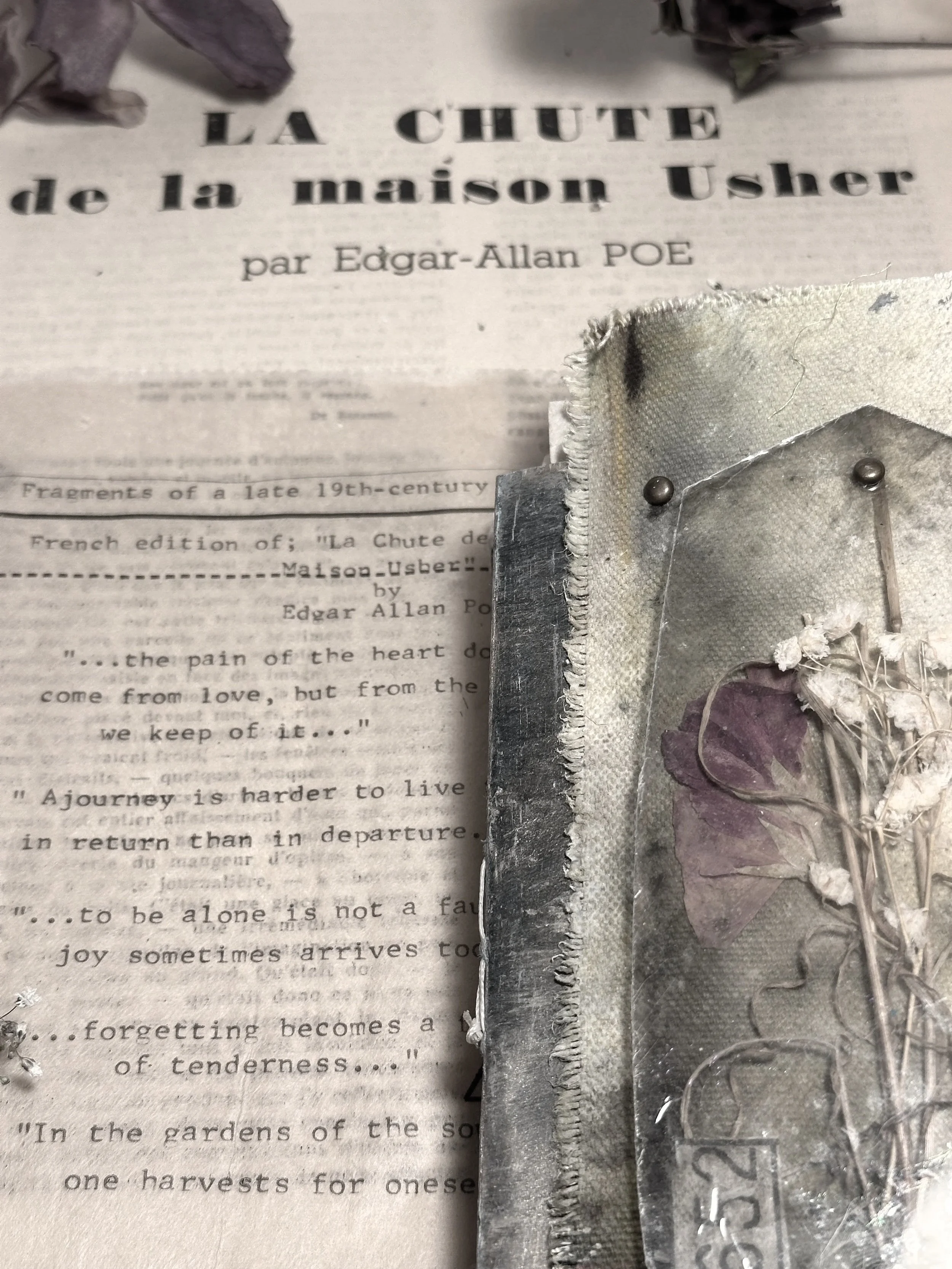
“Fragments of What Remains…”
Mixed media relic-form assemblage created using Printed fragments from “La Chute de la Maison Usher” - Edgar-Allan POE
I didn’t meet Edgar-Allan Poe, not really. But I met him the way artists do—through fragments, through touch, through a sentence that refuses to stay quiet. I was at my table assembling a piece built around “La Chute de la Maison Usher”. His name. His words. His house.I didn’t know, when I began, what the day would hold. The same day…just hours later, my husband’s family farm burned down. (all were safe but the sadness sifted in…)
A house as a living thing…
That morning, as I held Edgar-Allan Poe’s poetic literature (in french) and a translated fragments of his text, I kept returning to that idea: A structure can hold lives. It can remember them. By afternoon, the phone call came. The farm homestead was gone.
The house that had held my husband’s childhood—his parents, brother and sister…the good years and the unbearable ones—became ash in minutes.
Assembling while the ground shifts
I didn’t stop working. That may sound strange, but artists will understand. My hands kept moving because my body needed a way to hold what my mind couldn’t yet name. Elements pierced the surface like anchors. Threads wrapped and tangled. Pressed flowers—already dead, already preserved—were pinned beneath translucent layers. I wasn’t illustrating the fire. I wasn’t recreating the farm.
I was doing what assemblage allows: holding presence after loss.
Coincidence…why POE?
Edgar-Allan Poe wrote “The Fall of the House of Usher” in 1839, long before I was born, long before this farm existed. And yet his understanding feels immediate: That places can collapse not because they are weak, but because they have carried too much. When the house falls in his story, it does not simply crumble. It splits. It sinks. It disappears into itself. There is grief in that—but also release. The same day I was creating with his literary works that spoke to the collapse of a lineage…was the same day our family farm burnt down. I was oddly comforted by Edgar’s poetic understandings…they remain timeless.
A relic, not an illustration
This piece is not an homage. It is not literary fan art. It is a relic-form assemblage—a meeting point between a 19th-century voice and a present-day loss. Between text and touch. Between something that burned and something that remains. I did not plan for this work to carry this meaning. But art rarely asks permission.
What remains…
The farm is gone, but it is not lost. It lives in memory, in story, in the way certain places shape us long after they disappear. And now, unexpectedly, it lives inside a piece built with Poe’s words—quietly, without spectacle. That day, I didn’t meet Edgar-Allan Poe, but I met the truth he wrote about: That houses are more than wood and walls. And when they fall, something in us shifts forever. When the farm burned, what was lost was more than a building. It was a container for multiple lives, contradictions, and generations.